
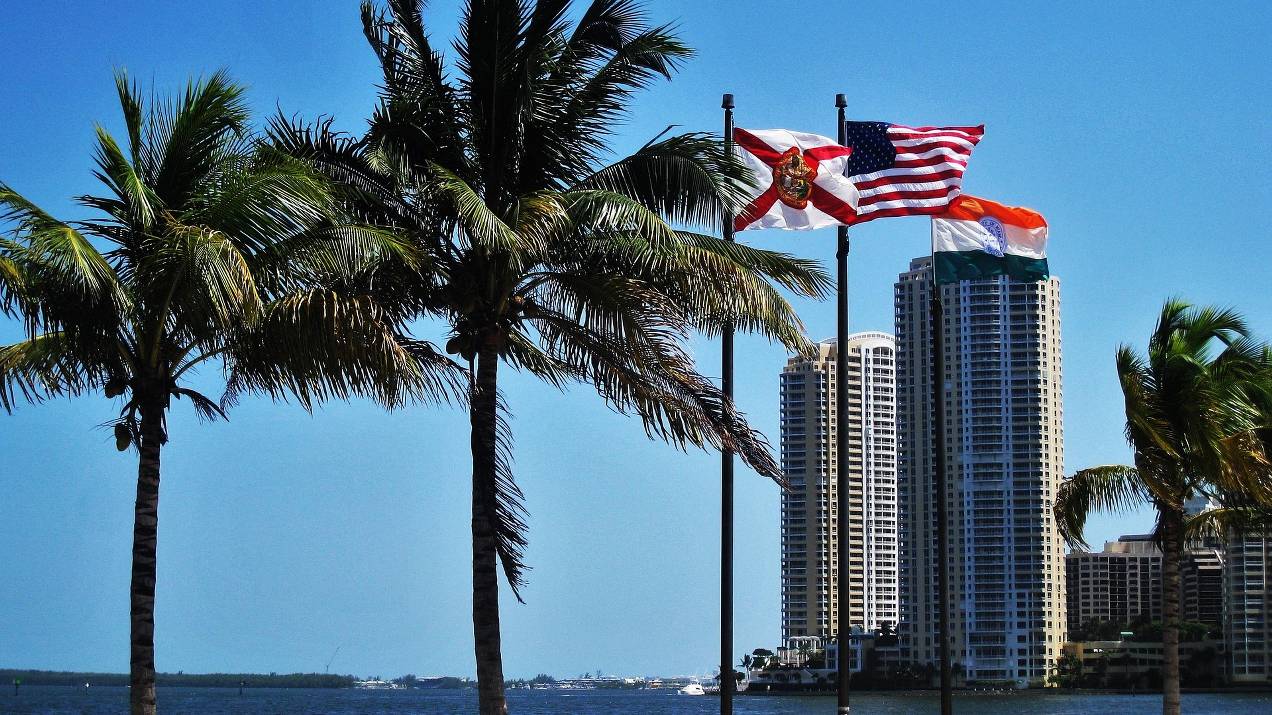
Cargo from Miami to Colombia: options, costs and transit times for Colombian companies
Miami is, without a doubt, the most important logistics hub in the Americas for Colombian companies. From the Port of Miami and Miami International Airport (MIA), shipments of all kinds of goods leave daily to Colombia: industrial machinery, spare parts, manufacturing inputs, electronic equipment, construction materials, tools, consumer products and much more. The geographical proximity, the frequency of shipping and air services, and the free trade agreement in force between Colombia and the United States make Miami one of the most efficient and competitive import routes for the Colombian market.
This guide explains in detail the options available for moving cargo from Miami to Colombia, with updated 2026 reference costs, real transit times and guidance on when each option is best suited depending on the type of goods and urgency of delivery.
Miami as a logistics hub for Colombia: why it matters
Miami concentrates a very significant share of trade between the United States and Latin America. For Colombian companies, this city has several logistical advantages that set it apart from other import origins:
- Geographical proximity: Miami is less than 2,000 kilometers from Colombia's Caribbean ports. Maritime transit to Barranquilla or Cartagena takes between 5 and 8 days, significantly less than from China (28–40 days) or Europe (18–28 days).
- Service frequency: there are shipping services with multiple weekly departures from the Port of Miami to Colombia, providing greater flexibility to schedule shipments without long waiting times.
- Competitive air freight: MIA is one of the world's most active cargo airports. Direct air connections to Bogotá, Medellín, Cali and Barranquilla are frequent, and air freight rates from Miami are generally more competitive than from Europe or Asia for urgent cargo.
- Colombia–U.S. FTA: in force since 2012, it allows most products originating in the United States to be imported into Colombia with a 0% tariff, provided the corresponding certificate of origin is submitted. This tariff benefit makes purchasing in Miami especially attractive for categories with high tariffs from other origins.
- Specialized consolidators: Miami has a highly developed logistics industry for Colombia, with multiple LCL consolidators specializing in the Miami–Colombia corridor that offer weekly services with competitive rates.
Transport options from Miami to Colombia
Option 1 — Full Container Load (FCL) ocean freight
FCL ocean freight is the most common option for Colombian companies that import regular volumes from Miami. The container departs from the Port of Miami, completes the maritime transit to Barranquilla, Cartagena or Santa Marta, and arrives at the customs-bonded warehouse for processing with the DIAN.
| Container type | Route | Maritime transit time | Estimated 2026 freight (USD) |
|---|---|---|---|
| FCL 20' | Miami → Barranquilla | 5 – 8 days | USD 800 – USD 1,800 |
| FCL 40' | Miami → Barranquilla | 5 – 8 days | USD 1,200 – USD 2,800 |
| FCL 20' | Miami → Cartagena | 4 – 7 days | USD 800 – USD 1,800 |
| FCL 40' | Miami → Cartagena | 4 – 7 days | USD 1,200 – USD 2,800 |
| FCL 20' | Miami → Buenaventura | 8 – 12 days | USD 1,200 – USD 2,400 |
| FCL 40' | Miami → Buenaventura | 8 – 12 days | USD 1,800 – USD 3,500 |
Compared to freight from China, rates from Miami are significantly more economical and transit times are four to five times shorter. This combination makes FCL ocean freight from Miami one of the most attractive logistics options in the Colombian import market.
Option 2 — Less than Container Load (LCL) from Miami
For companies with volumes that do not justify a full container, the LCL service from Miami is especially competitive due to the high frequency of consolidations available on this corridor.
| Modality | Route | Total transit time | Estimated 2026 rate | Minimum volume |
|---|---|---|---|---|
| LCL ocean | Miami → Barranquilla | 10 – 16 days | USD 60 – USD 120 per m³ | No minimum (generally from 0.5 m³) |
| LCL ocean | Miami → Cartagena | 10 – 16 days | USD 60 – USD 120 per m³ | No minimum |
| LCL ocean | Miami → Buenaventura | 14 – 22 days | USD 80 – USD 140 per m³ | No minimum |
One of the advantages of LCL from Miami compared to LCL from China is departure frequency. Consolidations to Colombia leave practically daily from Miami, meaning there is no waiting time to fill a container. Cargo ready today in Miami can be shipped tomorrow via LCL, whereas from China it may have to wait until the next weekly or bi-weekly consolidator departure.
Option 3 — Air freight from Miami to Colombia
Air freight from Miami is the preferred option for urgent goods, high-value items, perishables, or goods whose daily storage cost exceeds the difference between ocean and air freight.
| Air route | Transit time | Estimated 2026 rate (USD) | Notes |
|---|---|---|---|
| Miami → Bogotá (El Dorado) | 1 – 2 business days | USD 1.80 – USD 4.50 per kg | Highest frequency of direct flights from MIA |
| Miami → Medellín (Rionegro) | 1 – 3 business days | USD 2.00 – USD 5.00 per kg | Direct flights and connections through Bogotá |
| Miami → Cali (Alfonso Bonilla) | 1 – 3 business days | USD 2.00 – USD 5.00 per kg | Generally with connection through Bogotá |
| Miami → Barranquilla (Ernesto Cortissoz) | 1 – 3 business days | USD 2.20 – USD 5.50 per kg | More limited frequencies than to Bogotá |
Air freight is quoted based on the greater value between actual weight and volumetric weight (calculated as length × width × height in cm ÷ 6,000 for air cargo). For dense, heavy goods, actual weight applies. For bulky, lightweight goods, volumetric weight applies and the cost can be significantly higher than expected.
Option 4 — International courier and parcel services
For small packages, commercial samples, small spare parts or documents with commercial value, international courier services (DHL, FedEx, UPS) offer delivery times of 1 to 3 days from Miami to Colombia's main cities. This option has higher costs per kilogram than regular air freight, but includes customs clearance in Colombia and door-to-door delivery, making it convenient for small shipments that do not justify a formal import process.
Important note: for packages with a commercial value exceeding USD 200, the DIAN may require a formal import declaration even for courier shipments. It is advisable to consult with your customs agent if the package falls within that value range.
Comparison of options: when to use each one?
| Modality | When it works best | When it does not work well | Relative cost |
|---|---|---|---|
| FCL ocean | Volumes over 15–20 m³, regular imports, non-urgent cargo | Small volumes, urgent cargo or high-value cargo by weight | Most economical per m³ for high volumes |
| LCL ocean | Volumes under 15 m³, sporadic imports, testing new suppliers | High-value fragile cargo, urgent goods | Economical for low volumes; more expensive per m³ than FCL at high volumes |
| Air freight | Urgent cargo, critical spare parts, samples, high-value low-weight/volume products | Heavy or bulky cargo, low unit-value goods | Most expensive per kg/m³; justified when the cost of delay exceeds the freight difference |
| Courier | Small packages, samples, documents, low-weight low-value spare parts | High-volume commercial imports, goods valued over USD 200 requiring formal declaration | Most expensive per kg but includes customs clearance and door-to-door delivery |
The Colombia–U.S. FTA and its impact on imports from Miami
The Free Trade Agreement between Colombia and the United States, in force since May 2012, is one of the most important factors to consider when importing from Miami. For most industrial, manufacturing and general cargo products originating in the United States, the import tariff in Colombia is 0%.
The practical implications for a Colombian importer purchasing in Miami are significant:
| Product category | Tariff without FTA (from China) | Tariff with U.S. FTA (from Miami) | Savings on USD 30,000 CIF |
|---|---|---|---|
| Industrial machinery (ch. 84) | 0% – 5% | 0% | USD 0 – USD 1,500 |
| Portable electric tools | 5% – 10% | 0% | USD 1,500 – USD 3,000 |
| Hand tools (ch. 82) | 10% – 15% | 0% | USD 3,000 – USD 4,500 |
| Resins and plastics (ch. 39) | 5% – 15% | 0% | USD 1,500 – USD 4,500 |
| Paints and coatings | 10% – 15% | 0% | USD 3,000 – USD 4,500 |
| Measuring equipment (ch. 90) | 0% – 5% | 0% | USD 0 – USD 1,500 |
| Industrial spare parts and components | 5% – 10% | 0% | USD 1,500 – USD 3,000 |
To access the 0% tariff, the goods must originate in the United States — meaning they must have been produced or substantially transformed there — and the Colombian importer must submit the certificate of origin under the Colombia–U.S. FTA at the time of the import declaration with the DIAN.
An important point: many products purchased in Miami are manufactured in China or other Asian countries and are simply sold through distributors in the United States. These products do not originate in the U.S. and do not qualify for the FTA tariff preference, even if they were purchased in Miami. Before assuming a product qualifies for the 0% tariff, verify with the supplier whether they can issue a certificate of origin under the Colombia–U.S. FTA. If they cannot, the product will be subject to the general tariff even if it came from Miami.
Port of entry: Barranquilla, Cartagena or Buenaventura?
For cargo coming from Miami, the Colombian Atlantic Coast ports — Barranquilla and Cartagena — are the natural entry points due to their shorter maritime transit times. However, the choice of port of entry depends on the final destination of the goods within Colombia:
| Port of entry | Maritime transit from Miami | Convenient for final destination in | Estimated overland transport |
|---|---|---|---|
| Barranquilla | 5 – 8 days | Atlantic Coast, Barranquilla, Cartagena, northeastern region | Local or up to 4 hours within the Coast |
| Cartagena | 4 – 7 days | Atlantic Coast, Cartagena, Medellín (shorter distance than from Barranquilla) | Cartagena → Medellín: 10–14 hours |
| Buenaventura | 8 – 12 days | Cali, Medellín, Bogotá (when total freight is more competitive) | Buenaventura → Cali: 4–6 hours | → Medellín: 12–18 hours |
For companies with a final destination in Medellín or Bogotá, the difference in overland transit time may offset the shorter maritime transit of the Caribbean ports. Your freight agent can calculate the total door-to-door cost (ocean freight + port charges + overland transport) for each alternative and recommend the most convenient one.
Reference total costs: import from Miami to Medellín
To illustrate the total cost of an import from Miami, below is an example of an import of industrial equipment and tools in a 20-foot container with an FOB value of USD 18,000, destined for Medellín via the port of Barranquilla:
| Item | Value (USD) | Value (COP approx.) |
|---|---|---|
| FOB value of goods | USD 18,000 | COP 73,800,000 |
| FCL 20' ocean freight (Miami → Barranquilla) | USD 1,200 | COP 4,920,000 |
| Cargo insurance (0.6% on CIF) | USD 115 | COP 471,500 |
| CIF value (tax base) | USD 19,315 | COP 79,191,500 |
| Tariff (0% — tools under U.S. FTA) | USD 0 | COP 0 |
| Import VAT (19% on CIF) | USD 3,670 | COP 15,047,000 |
| THC destination (Barranquilla) | USD 250 | COP 1,025,000 |
| Customs brokerage (SIA) | USD 320 | COP 1,312,000 |
| Freight agent fees | USD 200 | COP 820,000 |
| Origin charges (Miami) | USD 220 | COP 902,000 |
| Overland transport Barranquilla → Medellín (20') | USD 780 | COP 3,198,000 |
| Total import cost | USD 25,755 | COP 105,556,500 |
| Surcharge over FOB value | +43.1% |
Compared to a similar import from China (where the same container would have freight costs of USD 2,200–2,800 and possibly tariffs of 5%–10%), importing from Miami with FTA benefits results in a lower total cost due to the combination of lower freight, shorter transit times and a 0% tariff. The difference can be between USD 3,000 and USD 6,000 per operation depending on the product's tariff rate.
Note: reference exchange rate of COP 4,100 per dollar.
Products most commonly imported from Miami to Colombia
The profile of imports from Miami to Colombia reflects both the industrial and commercial supply available in the United States and the needs of Colombia's productive sectors:
- Spare parts and components for industrial machinery: one of the most frequent categories. The availability of spare parts for American machinery or brands distributed in the U.S. is very high in Miami, with much shorter dispatch times than from manufacturers in Europe or Asia.
- Chemical inputs and plastics: resins, solvents, industrial adhesives, additives and raw materials for the chemical and plastics industries. Many of these products are available in Miami with U.S. certificates of origin that allow the 0% tariff.
- Industrial equipment and tools: brands such as Milwaukee, DeWalt, Snap-on, Hilti and others distributed in Miami are frequently imported by industrial hardware stores, distributors and maintenance companies.
- Electronic equipment and technology: servers, telecommunications equipment, automation systems and electronic components with distribution in Miami.
- Specialized construction materials: finishing products, waterproofing agents, high-performance paints and materials not easily found in Colombia.
- Products for the agro and industrial sector: fertilizers, agrochemicals, irrigation equipment and materials for the agro-industrial sector with a presence in Miami.
How consolidation in Miami works for Colombia
Miami has a highly developed network of consolidation warehouses (CFS, Container Freight Stations) specializing in the Colombia corridor. The typical process for an LCL import from Miami works as follows:
- The supplier in Miami delivers the goods to the consolidator's warehouse in Miami, which may be the same warehouse operated by the Colombian freight agent or its U.S. counterpart.
- The consolidator receives the goods, verifies them against the packing list and stores them until enough cargo is gathered to fill the container.
- Given the high frequency of operations on this corridor, the wait to fill the container rarely exceeds 2 or 3 business days, and in many cases departures are daily.
- The consolidator issues a master bill of lading and the Colombian importer receives the documents to manage the customs process in Colombia.
- Upon arrival in Colombia, the container goes to the deconsolidator's depot, which separates the cargo and makes it available to each importer.
Common mistakes when importing from Miami
- Assuming everything you buy in Miami has a 0% tariff: the FTA only applies to goods originating in the U.S. If you buy a product in Miami that was manufactured in China or a third country, it does not qualify for the tariff preference even if you paid for it in dollars from a seller in Florida.
- Not requesting the certificate of origin from the supplier: even if the goods originate in the U.S., the Colombian importer needs the supplier to certify that origin to present to the DIAN. Without the certificate, the DIAN will apply the general tariff even if the goods came from Miami.
- Always choosing air freight for speed: air freight from Miami is much faster, but also between 5 and 10 times more expensive per kilogram than ocean freight. For non-urgent goods, ocean freight is the right option. Air freight is only justified when the cost of not having the product on time exceeds the freight differential.
- Not calculating the total shipping cost including overland transport: a low ocean freight rate to Barranquilla may come with a high overland cost to Medellín or Bogotá. The correct analysis should always be based on the total door-to-door cost.
- Not checking restrictions for certain products: some products freely available in Miami may have import restrictions in Colombia: products containing chemical precursors, certain telecommunications equipment, food or health products. Before purchasing, verify whether your product requires any permit or approval from entities such as INVIMA, ICA or the Ministry of Communications.
Frequently asked questions about cargo from Miami to Colombia
How long does an ocean shipment from Miami to Barranquilla take?
The maritime transit from the Port of Miami to Barranquilla takes between 5 and 8 days under normal conditions. Add to this between 2 and 5 business days for customs processing with the DIAN with complete documentation and a green channel, plus the time for overland transport to the final destination. In total, an ocean import from Miami can reach Medellín or Bogotá in between 12 and 20 days from the date of shipment, which is significantly faster than from China or Europe.
Can I ship freight from Miami if I only have 1 or 2 cubic meters?
Yes. The LCL service from Miami accepts shipments from very small volumes, generally from 0.5 m³. For volumes of 1 to 2 m³, the LCL ocean freight cost from Miami to Colombia may range between USD 120 and USD 360, depending on the route and the consolidator's rate. For such small volumes, it is also worth evaluating courier or air freight, which can be faster with a not-so-large cost difference for very low weights and volumes.
How do I find a logistics provider to manage shipments from Miami to Colombia?
The most efficient way is to work with a Colombian logistics operator that has counterparts in Miami. This model gives you a single point of contact in Colombia that coordinates the entire operation: pickup from the supplier in Miami, consolidation at the counterpart's warehouse, shipping, customs clearance in Colombia and overland transport to your facility. You do not need to find a separate agent in Miami and another in Colombia.
Does air freight from Miami apply to all types of cargo?
Most general cargo can be transported by air from Miami. However, there are restrictions on dangerous goods (as defined under IATA regulations), such as certain chemicals, large quantities of lithium batteries, aerosols and other regulated materials. These types of goods require special declarations and handling by an agent certified in dangerous goods. Consult your freight agent before attempting to ship products that may fall under this classification.
Can I import from Miami without knowing my product's tariff code?
It is not advisable. The import declaration with the DIAN requires the product's tariff subheading, which determines the applicable tariff and VAT. Without knowing the subheading, you cannot calculate the total cost of the import or verify whether the product qualifies for the U.S. FTA. Your customs agent can identify the correct subheading, but needs a detailed technical description of the product to do so. Having the subheading identified before purchase allows you to calculate the real cost of the import and negotiate better with the supplier.
Conclusion
Miami is one of the most efficient and competitive import origins for Colombian companies. The combination of short transit times, high frequency of ocean and air services, access to high-quality North American brands and the FTA benefit of 0% tariffs for goods originating in the U.S. makes this corridor a first-class logistics option.
The key to making the most of this corridor's advantages is to work with a logistics operator experienced on the Miami–Colombia route, one that can manage freight, customs brokerage and overland transport from a single point of contact, and that can properly advise you on which products qualify for the FTA and how to obtain the corresponding certificates of origin.
If your company needs to move cargo from Miami to Colombia and you want a detailed quote or guidance on the process, contact us and we will get back to you within 24 hours.
