
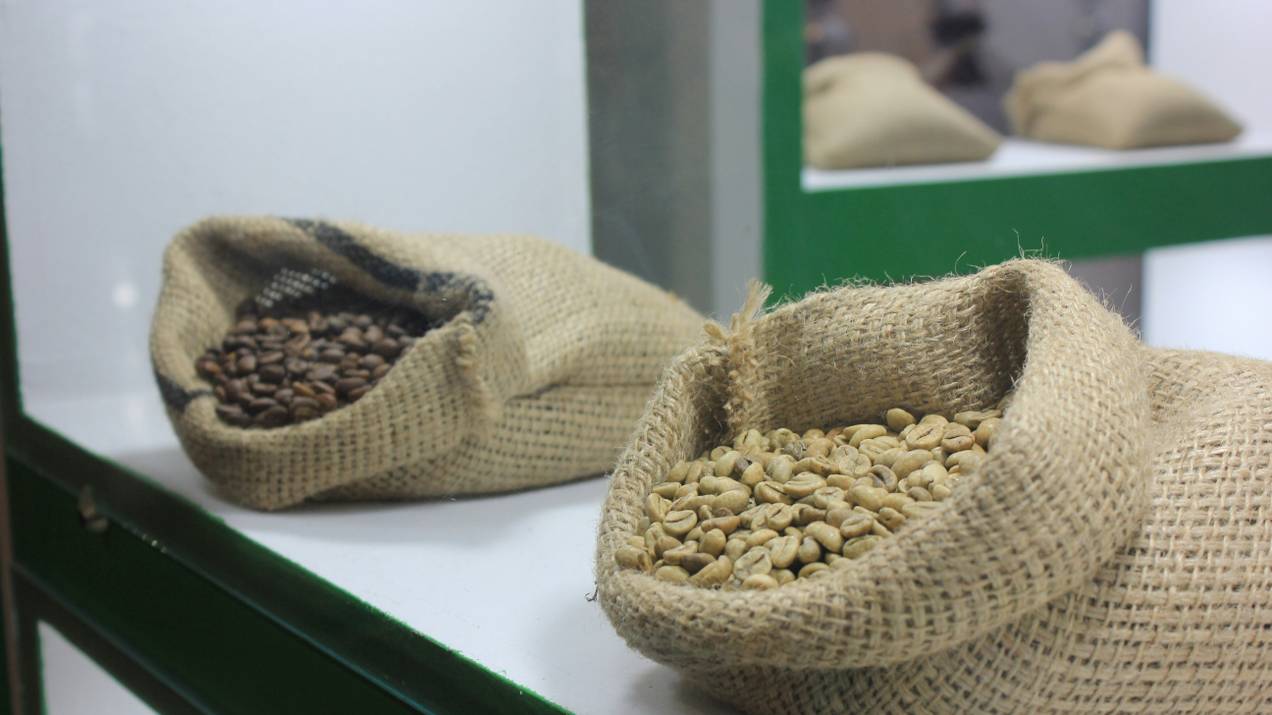
How Many Coffee Bags Fit in a Container?
Determining how many coffee bags fit in a container is one of the most common questions when planning a coffee export or import operation. The final quantity depends not only on the container size, but also on the weight of each bag, packaging dimensions, loading configuration, and applicable weight restrictions.
For an international buyer, knowing the approximate capacity before requesting a quote allows for better calculation of logistics costs per kilogram, proper selection of container type, and accurate purchasing volume planning.
In this guide, we explain how to calculate the number of coffee bags that a 20-foot or 40-foot container can transport and the main factors to consider.
How many coffee bags fit in a 20-foot container?
A 20-foot container can transport a significant volume of coffee, but the exact number of bags will primarily depend on the unit weight of each bag and cargo specifications.
For example, using 60 kg bags, a shipment of 300 bags represents approximately 18,000 kg of coffee. However, the final quantity must be calculated by taking into account the total allowable payload for the container and specific route regulations.
| 60 kg Bags | Approximate Coffee Weight |
|---|---|
| 250 bags | 15,000 kg |
| 275 bags | 16,500 kg |
| 300 bags | 18,000 kg |
| 325 bags | 19,500 kg |
These values serve as mathematical examples to understand the relationship between bag count and total weight. Real operational capacity must be validated based on specific shipment conditions.
How many coffee bags fit in a 40-foot container?
A 40-foot container offers greater volumetric capacity than a 20-foot container, but this does not necessarily mean double the amount of coffee can be loaded. For high-density commodities like coffee, maximum weight limits are often reached before using all available volume.
For instance, with 60 kg bags, 500 bags represent 30,000 kg of coffee. However, the actual loadable quantity must be determined according to applicable weight limits and transport regulations.
| 60 kg Bags | Approximate Coffee Weight |
|---|---|
| 400 bags | 24,000 kg |
| 450 bags | 27,000 kg |
| 500 bags | 30,000 kg |
| 550 bags | 33,000 kg |
The examples above demonstrate how total weight scales relative to bag count. Maximum actual capacity must be verified prior to booking container equipment.
How many 70 kg coffee bags fit in a container?
Individual bag weight significantly impacts total container capacity. A 70 kg bag transports more coffee per unit, but causes container weight limits to be reached with fewer total units.
| Bag Quantity | Weight with 70 kg Bags |
|---|---|
| 250 bags | 17,500 kg |
| 300 bags | 21,000 kg |
| 350 bags | 24,500 kg |
| 400 bags | 28,000 kg |
In addition to net coffee weight, packaging materials and cargo preparation supplies must be factored into total gross weight calculations.
How many 60 kg coffee bags fit in a container?
The 60 kg bag is a standard unit presentation in commercial coffee trade. To calculate total loadable units, establish the target total weight first, then divide by individual unit weight.
The baseline calculation formula is:
Number of bags = total coffee weight ÷ weight per bag
For example, targeting a 20,000 kg total volume packed in 60 kg bags:
20,000 ÷ 60 = 333.33 bags
In practice, bag quantities are rounded down to full units and adjusted according to allowable gross payload limits.
Does the number of coffee bags depend on volume or weight?
It depends on both. Accurately determining container capacity requires evaluating cargo weight and volume parameters simultaneously.
For coffee, weight limits are frequently the primary constraint due to bulk product density. A container may have physical volumetric space remaining, yet additional bags cannot be loaded once max payload weight limits are hit.
| Factor | Impact on Capacity |
|---|---|
| Weight per bag | Determines the weight contribution of each unit. |
| Bag dimensions | Determines the volumetric space occupied by each unit. |
| Cargo stowing configuration | Affects internal container space optimization. |
| Maximum allowable weight | May limit total coffee volume prior to filling total container volume. |
What factors determine how many bags fit in a container?
Final bag counts depend on several specific cargo attributes and transport conditions.
Primary factors include:
- Container type.
- Individual bag weight.
- Individual bag dimensions.
- Total bag count.
- Total weight.
- Total volume.
- Use of pallets.
- Stowage and stacking arrangement.
- Weight restrictions.
- International route regulations.
- Ocean carrier requirements.
Estimating loadable volume purely based on container nominal dimensions can lead to inaccurate planning.
What is the difference between a 20-foot and a 40-foot container for coffee?
The primary difference lies in internal volumetric capacity. However, for heavy commodity shipments like coffee, it should not be assumed that a 40-foot container will yield double the net cargo capacity of a 20-foot equipment unit.
| Feature | 20-Foot Container | 40-Foot Container |
|---|---|---|
| Length | Smaller internal capacity | Greater internal capacity |
| Volume | Suitable for standard commercial batch volumes | Greater volumetric space available |
| Coffee Loading | Often constrained by weight limits | Often constrained by weight limits prior to filling volume |
| Usage | Moderate commercial export volumes | Larger commercial volume orders |
Should pallets be used to transport coffee bags?
Pallet usage depends on operational preferences, packaging types, buyer requirements, and destination handling capabilities.
Floor-loading (loose stacking) bags directly inside the container optimizes space utilization, though it may require specific manual labor procedures during loading and unloading.
Using pallets streamlines handling operations at facilities, but adds pallet weight and volumetric displacement, reducing net usable coffee space.
Cargo configuration should be finalized prior to equipment reservation.
How to calculate the volume of coffee bags?
Calculating approximate individual bag volume requires three dimensional metrics: length, width, and height.
The standard formula is:
Volume = length × width × height
Ensure all dimensions use identical unit measurements. If measured in centimeters, convert the result to cubic meters (CBM).
Multiplying individual bag volume by total bag quantity yields total estimated shipment volume.
How to calculate total coffee bag weight?
Calculating total shipment weight is straightforward when bags feature uniform weight parameters.
The calculation formula is:
Total weight = number of bags × weight per bag
For example, a shipment of 300 bags weighing 70 kg each:
300 × 70 kg = 21,000 kg
Include packaging weight (tare) and additional securing accessories when compiling gross transport weight quotes.
How much coffee can be loaded into a container?
There is no single uniform quantity that applies universally to all shipments. Loading capacity must be determined based on specific product specifications.
Key parameters required for an initial estimate include:
- Container type.
- Weight per bag.
- Dimensions per bag.
- Bag quantity.
- Total net weight.
- Total volume.
- Cargo stowing setup.
- Transport road/ocean weight limits.
Logistics operators utilize these details to verify feasibility for proposed container options.
How many kilos of coffee fit in a container?
Kilogram capacity depends on container type, gross weight restrictions, and route rules. Container volumetric capacity must not be confused with allowable payload weight capacity.
Maximum payload limits are frequently governed by overland highway weight regulations, port handling rules, and ocean carrier policies.
Always validate gross weight parameters with your logistics service provider before dispatching shipments.
How does coffee type affect bag count capacity?
Coffee type indirectly impacts bag counts because product forms dictate presentation sizes, unit weights, and packaging styles.
For example, bulk green coffee in standard export bags features different stowing configurations than roasted coffee packaged in retail/wholesale bags for commercial distributors.
Calculations should always reflect the exact dimensions and weight parameters of the specific export presentation.
How to calculate required bag quantities for coffee exports?
When planning an export shipment, establish total desired coffee volume first, select bag specifications, and calculate required units accordingly.
- Define total coffee volume.
- Define unit weight per bag.
- Define individual bag dimensions.
- Select container size/type.
- Calculate total net weight.
- Calculate total volumetric CBM.
- Verify route weight restrictions.
- Determine cargo stowing setup.
- Confirm capacity with logistics provider.
Following this process mitigates the risk of booking improper equipment for your shipment.
What information does a freight forwarder need to quote a coffee container?
To provide accurate container freight quotes, logistics providers require specific cargo parameters.
| Information Field | Sample Detail |
|---|---|
| Product | Green coffee |
| Quantity | 300 bags |
| Weight per Bag | 60 kg |
| Total Weight | 18,000 kg |
| Dimensions | Per-bag unit dimensions |
| Origin | City/Loading origin in Colombia |
| Port of Loading | Colombian port of departure |
| Destination | International port of arrival |
Common mistakes when calculating coffee container capacity
Assuming a 40-foot container holds twice as much coffee as a 20-foot container
Payload capacity is bound by weight and volume. For coffee, weight restrictions are usually the primary limitation.
Calculating exclusively by volume
Cubic meter calculations alone overlook strict road and ocean carrier weight restrictions.
Ignoring packaging tare weight
Sack material, pallets, liners, and securing items contribute to gross payload and must be calculated.
Neglecting real-world bag dimensions
Filled bag dimensions vary based on fill level, settling, and packing technique.
Failing to verify specs with logistics providers
Always review final stowing plans against route regulations before confirming transport bookings.
How to optimize container space for coffee shipments?
Proper load planning maximizes usable space while preventing cargo movement during transit.
Recommended optimization practices include:
- Uniform bag sizing and filling.
- Row pattern optimization.
- Evaluating floor-loading vs. palleted stowing.
- Proper weight distribution.
- Cargo stack height management.
- Handling accessibility.
- Product protection measures.
Stowage plans should balance space optimization, cargo safety, and legal weight limits.
How to transport coffee bags from Colombia?
Ocean shipping is the standard mode for commercial exports when volume justifies full container load (FCL) bookings.
Export operations involve inland transit from origin facilities to Colombian ports, customs export clearance, ocean shipping, and import clearance at destination.
Importers should define target volumes, packaging, origins, destinations, and Incoterms to obtain tailored freight proposals.
How to plan a coffee container shipment from Colombia?
Effective shipment planning starts with detailed product specifications rather than arbitrary equipment selection.
Prior to requesting quotations, define:
- Type of coffee.
- Green or roasted state.
- Bag count.
- Weight per bag.
- Total weight.
- Bag dimensions.
- Packaging type.
- Pallet usage (if applicable).
- Origin location.
- Port of departure.
- Port of destination.
- Incoterm.
- Estimated shipment date.
With these details in hand, operators can evaluate whether 20-foot or 40-foot equipment is optimal for your requirement.
Looking to export Colombian coffee in containers?
Nextstop Trading operates as a supplier and commercial distributor of Colombian products for international buyers. We evaluate green and roasted coffee requirements based on volume, presentation, specifications, commercial terms, and destination markets.
We structure logistical frameworks to move coffee from Colombia, coordinating international transport options through our logistics allies.
Need a quote for a coffee container from Colombia?
Share your total bag count, unit bag weight, coffee type, origin, destination port, and required Incoterm with our team. We will analyze your cargo details to identify suitable commercial and logistics options.
Frequently asked questions about coffee bags in containers
How many coffee bags fit in a 20-foot container?
Quantity depends on bag weight, dimensions, and applicable weight limits. There is no single universal figure for all shipments.
How many coffee bags fit in a 40-foot container?
A 40-foot container offers larger volumetric space, but cargo weight limits often cap total coffee capacity before using all physical space.
How many kilos of coffee fit in a container?
Kilogram capacity varies based on container type, gross weight restrictions, bag specifications, and route regulations. Capacity must be calculated per operation.
How many 60 kg coffee bags fit in a container?
Determined by maximum allowable weight limits. For example, 300 bags of 60 kg equal 18,000 kg of net coffee, excluding packaging tare weight.
How many 70 kg coffee bags fit in a container?
Capacity depends on overall weight limits and loading configuration. Higher unit bag weight reaches overall payload limits with fewer total bags.
Is a 20-foot or 40-foot container better for coffee?
It depends on operational volume and total weight. Selection should account for real cargo payload capacity, freight costs, and route weight rules.
Should coffee be shipped on pallets?
Not necessarily. Configurations vary based on packaging, buyer requirements, and handling equipment. Pallet weight and volume displacement must be calculated.
